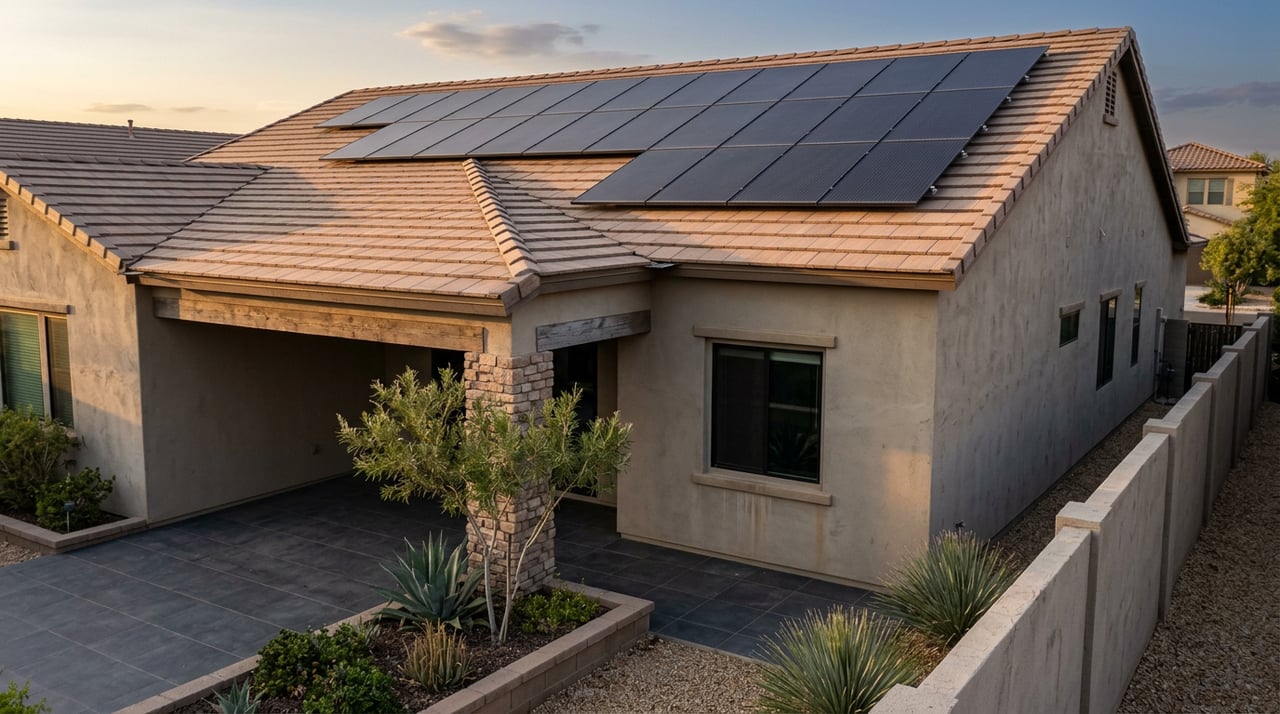
Ask most buyers what they want to hear about a Skye Canyon home with solar panels, and the answer is almost always the same: owned, not leased. It's decent shorthand. But it skips the number that actually determines what those panels are worth, and that number has nothing to do with who holds title to the equipment on the roof.
It has to do with the date the system was switched on.
Three Words That Matter More Than "Has Solar"
Any solar system on a Skye Canyon home falls into one of three categories: owned outright, financed with a solar loan, or held under a lease or power purchase agreement. Each one behaves differently at the closing table.
A leased system, or one under a PPA, is the category that catches people off guard.
That's the version of this story most solar guides stop at. In Skye Canyon, there's a second layer underneath it.
What the Panels Are Attached to Matters Less Than When They Went Up
Nevada's rooftop solar credit system, run by NV Energy under a framework the legislature set in 2017, pays solar homeowners for the extra power their panels send back to the grid. That credit rate isn't flat. It's tiered, it declines over time, and once a homeowner locks in a tier, they keep it for 20 years at that same address, according to the Public Utilities Commission of Nevada.
Here's the tier structure, and the dates each one closed to new applicants:
| Tier | Credit Rate (% of retail) | Closed to New Applicants |
|---|---|---|
| Tier 1 | 95% | August 2018 |
| Tier 2 | 88% | June 2019 |
| Tier 3 | 81% | June 2020 |
| Tier 4 | 75% | Still open (no cap) |
Skye Canyon's first model homes, built by Pulte and Woodside, opened in the fall of 2018, according to the community's own site. That means a meaningful share of the earliest Skye Canyon solar installs, whether owned, financed, or leased, landed somewhere in Tier 1 through Tier 3. Any solar system going in today lands in Tier 4, at 75% of the retail rate, for 20 years at that same address.
Put plainly: a Skye Canyon home with a solar lease from 2018 or 2019 may carry a utility credit rate that's 13 to 20 percentage points better than a brand new system installed this year. The PUC's language is specific on this point, the locked rate stays with the system's original installation address for the full 20 years, not with the original owner. A new buyer who takes over that house, and takes over the utility account tied to it, inherits the tier along with it.
Why This Flips the Usual Advice
The standard warning about leased solar treats every lease as equivalent, when a 2019-vintage Skye Canyon lease and a 2026 lease are not the same product. One comes with a Tier 2 or Tier 3 rate locked for years to come. The other starts at Tier 4 with no room to improve.
This doesn't make leased solar automatically the smarter buy. It means the question a buyer should be asking isn't "owned or leased." It's "what tier, and how many years are left on the lock." A seller who can produce the original interconnection paperwork showing an early tier assignment has a genuine selling point that a newer, even owned, system can't match on the utility credit side alone.
The Timeline Problem at Closing
None of this changes the fact that lease and PPA transfers take real time, and real time is the thing that derails a closing date more often than price does.
According to Solar Equity Solutions, solar companies commonly ask for 30 to 60 days' notice before a sale, and once a buyer is identified, the transfer paperwork, credit review, and lease reassignment can add another two to four weeks on top of a standard escrow. Companies like Blue Raven, Sunlux, and Vivint each run this process at their own pace, and that pace is rarely something either agent controls.
A solar lease buyout typically falls somewhere between $5,000 and $30,000 depending on system size and years remaining.
One More Line Item Just Changed
Skye Canyon sellers and buyers evaluating a solar home in the second half of 2026 also need to account for a shift that has nothing to do with the panels themselves. The Public Utilities Commission of Nevada approved a rate redesign for NV Energy in September 2025 that added a new daily demand charge to residential bills starting April 1, 2026. NV Energy's own estimate puts the added cost to rooftop solar customers at roughly $12 a month under the new structure.
That's not large enough to change whether solar makes sense on a given Skye Canyon home. It is large enough that a seller pulling twelve months of utility bills to show a buyer should flag the April changeover, since bills from earlier in the year won't reflect the current cost structure going forward.
What This Means at the Closing Table
For sellers, the paperwork worth locating before listing isn't just the lease agreement. It's the original interconnection approval from NV Energy, which shows the tier assignment and the date it was locked. That single document turns "the house has solar" into a specific, dated claim a buyer's agent can verify.
For buyers, the question to ask isn't limited to lease versus owned. Ask for the interconnection date, ask which tier the system falls under, and ask how many of the 20 years remain. A Tier 2 system with fourteen years left on the clock is a materially different asset than a Tier 4 system installed last spring, even if the monthly lease payment looks identical on paper.
A Few Questions Worth Asking Before You Write an Offer
Does an older solar lease automatically lower a Skye Canyon home's value? Not necessarily. The lease payment matters, but so does the locked utility rate underneath it. A favorable tier can offset a less favorable lease structure.
If I buy a home with solar that's already paid off, do I get the same net metering rate the original owner had? In most cases, yes. The rate is locked to the installation address for 20 years under NV Energy's tariff structure, not to the person who signed up.
When should I start the solar transfer process? Starting that process early in escrow matters more than most buyers expect.
Solar adds a layer to a Skye Canyon transaction that a lot of national home-buying guides gloss over, because most of those guides aren't written with this community's specific build timeline in mind. If you're weighing an offer on a home with panels already installed, or getting ready to list one, it's worth walking through the actual paperwork before a number on a listing sheet becomes a surprise in escrow.
If you'd like a second set of eyes on what a specific Skye Canyon solar disclosure actually means for your offer or your listing, Baylee Collins is happy to help you sort through it. Let's connect.
This article is general information, not legal, tax or financial advice. Consult a qualified professional about your situation.